 free shipping for orders over $100*
free shipping for orders over $100*
Most dog harnesses and leads never get properly tested. A steady walk, a bit of sniffing, home again. Under those conditions almost anything holds.
The problem is that gear isn’t tested by ordinary walks. It’s tested by the one second nobody planned for — a cat across the footpath, a bike out of nowhere, another dog off-lead. That’s when a 40-kilo dog goes from walking beside you to putting its entire bodyweight against whatever you’re holding.
That’s the moment cheap gear fails. And it doesn’t fail randomly. It fails in the same few places, for the same few reasons.
1. The hardware fails before the fabric does
This is the big one, and it’s counterintuitive.
People look at webbing when they’re assessing a harness — how wide it is, how strong the fabric feels. But webbing is rarely what gives way. The failure point is almost always the hardware: the buckle, the clip, the snap hook.
A plastic side-release buckle is fine holding a jacket closed. It is not fine absorbing the shock load of a large dog hitting the end of a lead at speed. Plastic doesn’t stretch and then recover — it holds, holds, holds, and then shatters. Usually without warning, usually at the exact moment of maximum load.
Metal hardware behaves differently. It deforms before it breaks, which means it usually gives you warning, and it takes far more force to get there.
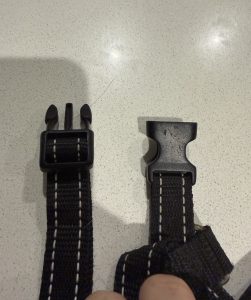
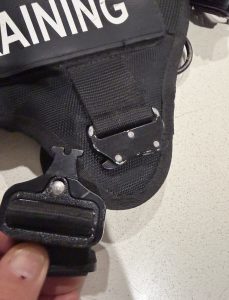
What to check: pick the harness up and look at every point where something clips, buckles or joins. If those parts are plastic on a harness meant for a large dog, that’s your failure point. It doesn’t matter how good the webbing is.
2. Thin webbing hides in plain sight
Webbing width gets advertised. Webbing thickness rarely does — and thickness is where corners get cut, because it’s invisible in a photograph.
Two harnesses can both claim 25mm webbing. One is substantial and dense; the other is thin, floppy, and half the weight. On a screen they look identical. In your hand the difference is instant.
This is why the same thing happens at every market we do. Someone picks up one of our harnesses, and before they’ve asked a single question, they say: this is solid. They’re not reading a spec sheet. They’re feeling the density of the material and the weight of the metal.
What to check: hold it. If you can’t hold it, look at the stated weight. A harness built for a large dog that weighs almost nothing has saved that weight somewhere, and weight in this context is material.
3. Stitching at the load points
Every harness has a few places where all the force concentrates: where the D-ring attaches, where straps join, where the handle is anchored.
Cheap gear runs a single line of stitching through those points. Better gear uses box stitching or bar tacking — a dense, reinforced pattern designed to spread load across a wider area of webbing rather than concentrating it on one line of thread.
Single-line stitching under repeated shock loading does something specific: it doesn’t snap all at once. It works loose, a few threads at a time, over weeks. By the time you notice, it’s been weakening for a while.
What to check: look at the stitching around the D-ring and handle. Dense, boxed, or crossed patterns are what you want. A single row of straight stitching on a major load point is a warning.
4. The D-ring itself
The D-ring is where your lead attaches, which makes it the single most loaded component on the harness.
Look for whether it’s welded closed or simply bent into shape. An unwelded ring is a gap held together by nothing but the shape of the metal — under enough lateral force, it opens.
Then look at how it’s anchored. Done properly, the ring sits in reinforced webbing with either dense stitching or metal plates riveted through multiple layers. Done cheaply, it’s attached to a single layer of thin fabric and the fabric tears out long before the ring does.
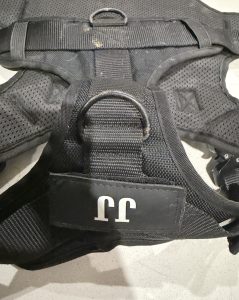
What to check: run a finger around the ring. If you can feel a seam where the two ends meet without a weld, that’s a weak point. Then check what it’s mounted to — the anchor matters as much as the ring.
Why we care about this
We didn’t start Bad Pets from a market opportunity. We started it because a lead broke.
My shepherd lunged at a cat, and the lead snapped at the buckle clip — the cheapest component. He chased the cat under a parked car, and that gave me the seconds I needed to get a hand on his collar. It ended fine. It ended fine because of where the cat chose to hide.
That’s not a safety system. That’s luck.
So when we specced our gear, we chose the components built to hold: thicker webbing, metal buckles instead of plastic, hardware that has to be forced rather than persuaded. It costs more to make. It weighs more. That’s the point.
We use it on a working German Shepherd and on protection-trained Dobermans — dogs that generate real force and put equipment under loads most harnesses will never see. If something’s going to fail, it fails on them first.
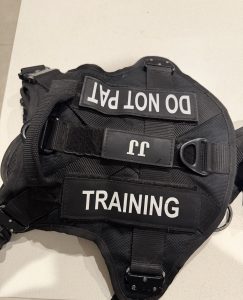
The harness in the photos below has been in regular use on those dogs for three years.
It doesn’t look new. The mesh lining is scuffed, and there’s some fraying at the edges of the padding. That’s what three years of actual work does to fabric.
But look at what hasn’t changed. The D-ring is still welded closed and seated in its webbing. The metal buckle still locks. The cam-lock adjusters still hold their setting.
That’s the distinction worth understanding: fabric wears, hardware fails. Wear is visible, gradual and harmless. Failure is invisible, sudden, and happens at the worst possible moment. You want gear where the parts that wear are the parts that don’t matter.
Beside it is a competitor’s plastic side-release clip — the same style of component, and the same style that snapped on my lead.
That’s the whole argument, in one photo.
The short version
If you’re assessing dog gear for a large dog, in order of importance:
1. Metal hardware, not plastic — this is where things break
2. Weight and thickness — light means less material
3. Reinforced stitching at load points — box stitching, not single lines
4. Welded D-ring — properly anchored to reinforced webbing
None of this matters on a calm walk. All of it matters in the one second that isn’t calm.
Every point above is why our gear is specced the way it is. Metal where the load goes, bound edges, stitching that holds. Australian-owned, stocked in Australia, tested on our own working dogs.
The Tactical Dog Harness is the one to look at first — metal quick-release buckle, welded D-rings, spacer-mesh lining. The Dog Leash is the piece that started all of this.